01
The Bottleneck
ConvNeXtBase → 8-Qubit Circuit
Information bottleneck. 1024 features crushed into 8 qubits, collapsing any expressive structure downstream.
FailedA comparative study asking whether Hybrid Quantum-Classical networks can outperform a standard CNN in low-data melanoma classification. Four experiments, three dead ends, one verified quantum advantage.
Research Question
Does adding a quantum processing layer improve deep learning performance for melanoma detection?
Tested multiple Quanvolutional architectures against identical classical controls. After three failed experiments, Experiment 4 demonstrated a measurable quantum advantage on data-scarce melanoma classification.
Four experiments ran end to end. Each node on the timeline records what was tried, what broke, and what survived.
ConvNeXtBase → 8-Qubit Circuit
Information bottleneck. 1024 features crushed into 8 qubits, collapsing any expressive structure downstream.
FailedQuantum filter as feature extractor
Multiple iterations either overfit aggressively or matched the classical control point for point. No usable signal.
FailedSimplified circuit · 9,942 test images
High recall (79%) traded for poor precision (42%). The output bottleneck pushed the model toward a single class.
PartialResNet18 + Data Re-uploading + Projective Measurement
Quantum advantage verified: +6.4% accuracy, +6.7% precision, better generalization on the held-out set.
SuccessThe four moves that made Experiment 4 actually work.
Partially unfrozen classical backbone.
196 feature patches — 4× the previous resolution.
Features encoded twice to inject non-linearity into the circuit.
Projective output, up from 8 dimensions.
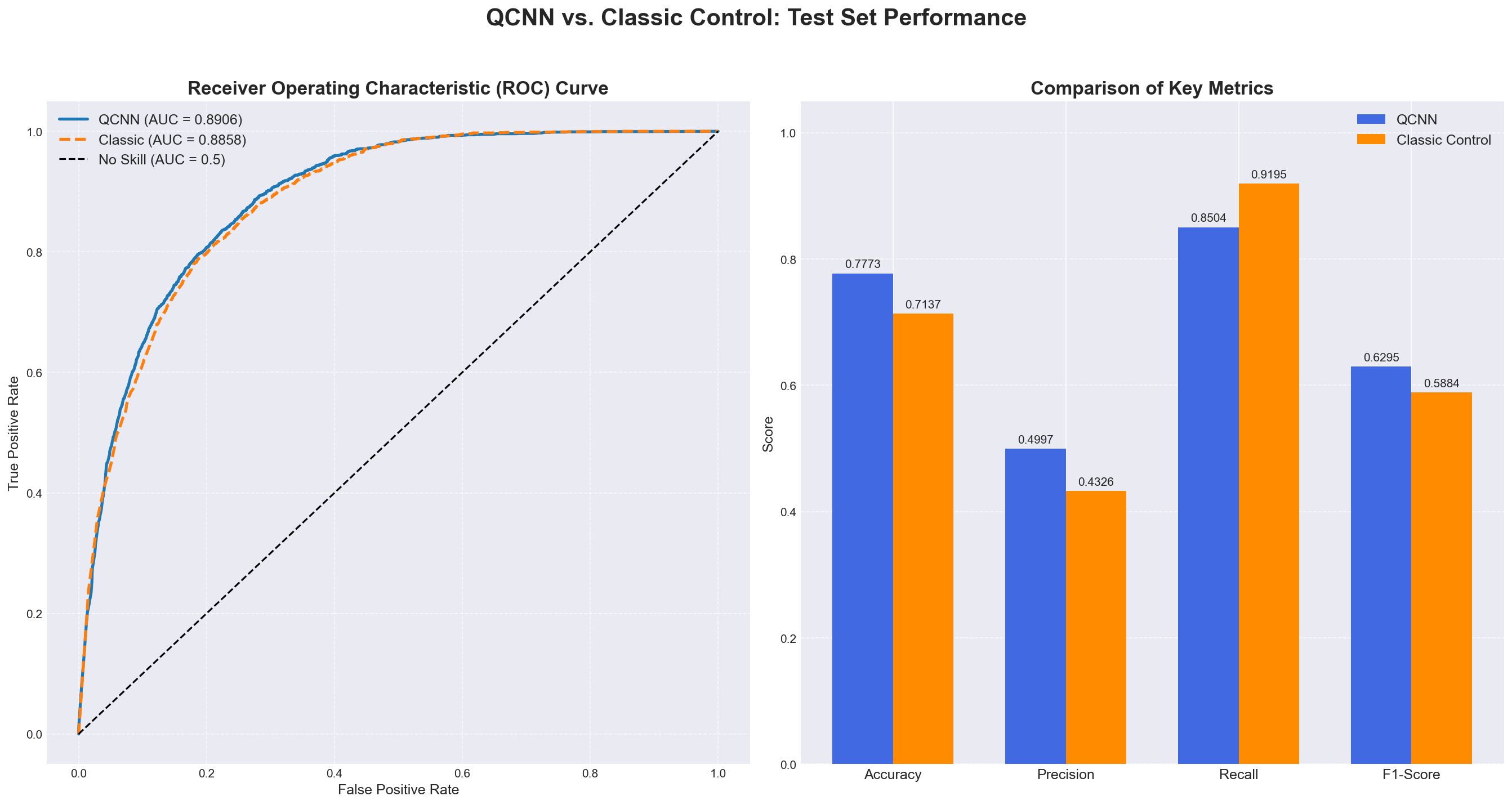
Head to head on the held-out test set. Same data, same backbone — only the quantum layer differs.
Finding
QCNN wins four of five metrics.
Classical edges recall only because it over-predicts the positive class. QCNN actually learns to discriminate — accuracy, precision, F1, and AUC all rise together.
Anti-overfitting effect
The classical model drove training loss down to 0.06 while validation loss climbed to 0.79. The QCNN stayed balanced, acting as a natural regularizer on a small dataset.
Learning to discriminate
Classical models inflated recall by calling almost everything positive. The QCNN kept 85% recall while actually raising precision — a meaningfully different behaviour.
High-dimensional feature space
Data Re-uploading and Projective Measurement expanded the output from 8 to 256 dimensions, enabling finer-grained discrimination between visually similar lesions.
A properly designed hybrid quantum-classical architecture — with Data Re-uploading and high-dimensional projective measurement — can outperform an equivalent classical model on tasks that demand generalization from limited data.
Not a clinical result, not a universal claim — a narrow, reproducible advantage on one real problem. Enough to justify pushing the architecture further.
Related Research
The high-performance ConvNeXtBase ensemble achieving 98.59% recall for clinical melanoma detection.
The repository holds every experiment, the failed iterations, the training scripts, and the notebooks used for the final comparison.